
Architecture
TOC
Overview
Tekton Pruner is a Kubernetes controller system that automatically manages the lifecycle of Tekton PipelineRun and TaskRun resources. It follows the Kubernetes operator pattern, implementing event-driven and periodic reconciliation to enforce configurable time-based (TTL) and history-based pruning policies.
Architecture Principles
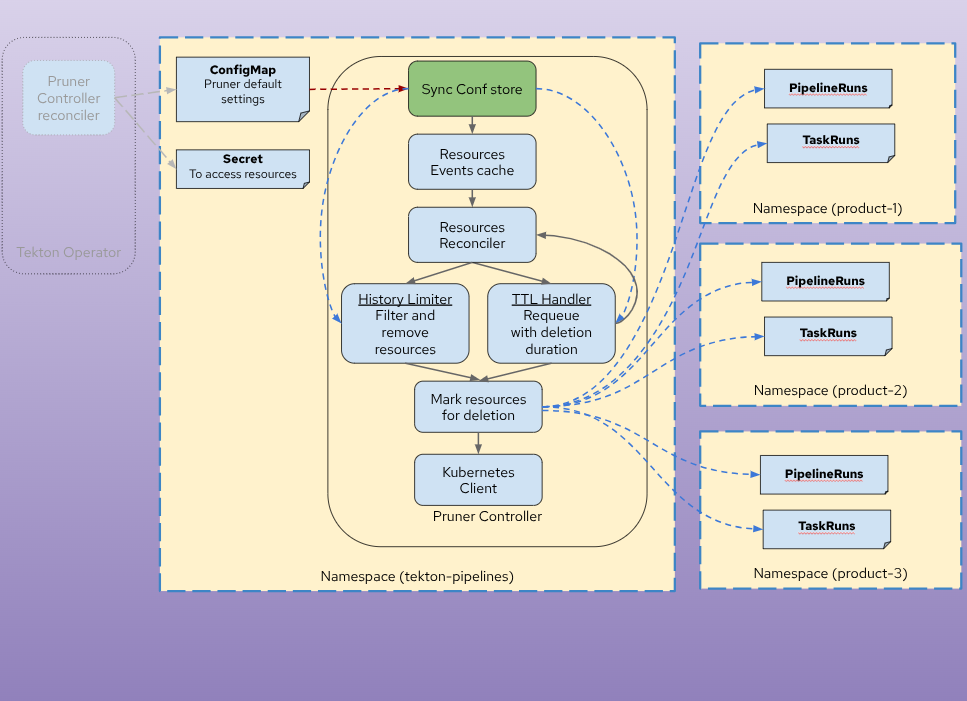
1. Controller Pattern Implementation
- Reconciliation Loops: Multiple controllers watch and react to resource changes
- Event-Driven Processing: Controllers respond to Kubernetes events (ConfigMaps, PipelineRuns, TaskRuns)
- ConfigMap-Driven Configuration: Declarative policy specifications
2. Hierarchical Configuration Model
- Three-Level Hierarchy: Global → Namespace → Resource Selector
- Precedence-Based Resolution: More specific configurations override general defaults
- Flexible Enforcement Modes: Configurable granularity (global, namespace, resource)
3. Separation of Concerns
- TTL Handler: Time-based cleanup logic
- History Limiter: Count-based retention logic
- Selector Matcher: Resource identification and matching
- Validation Webhook: Admission-time configuration validation
4. Kubernetes-Native Design
- Controller Runtime: Leverages controller-runtime framework
- Annotation-Based State: TTL values stored in resource annotations
- Minimal RBAC: Only requires list, get, watch, delete, patch permissions
- Namespace Isolation: Per-namespace configuration independence
Component Interactions
Controller Responsibilities
Core Logic Components
Design Decisions
Why Event-Driven + ConfigMap-Triggered GC?
- Event-Driven (PipelineRun/TaskRun): Immediate annotation updates and history limit enforcement
- ConfigMap-Triggered GC: Full cluster scan for TTL cleanup when configuration changes
- Efficient Design: Avoids constant polling, only cleans up when policies change
Why Hierarchical Configuration?
- Flexibility: Single-tenant (global) or multi-tenant (namespace) support
- Delegation: Namespace owners control their own retention policies
- Centralized Defaults: Platform teams set reasonable fallbacks
Why Separate TTL and History?
- Independent Concerns: Time-based vs count-based retention are different requirements
- Combined Use: Both can apply simultaneously (shortest retention wins)
- Clear Semantics: Each mechanism has distinct configuration and behavior
Why Annotations for TTL State?
- Auditability: TTL value visible in resource metadata
- Debugging: Users can inspect computed TTL on resources
- Idempotency: Prevents recomputation on every reconcile